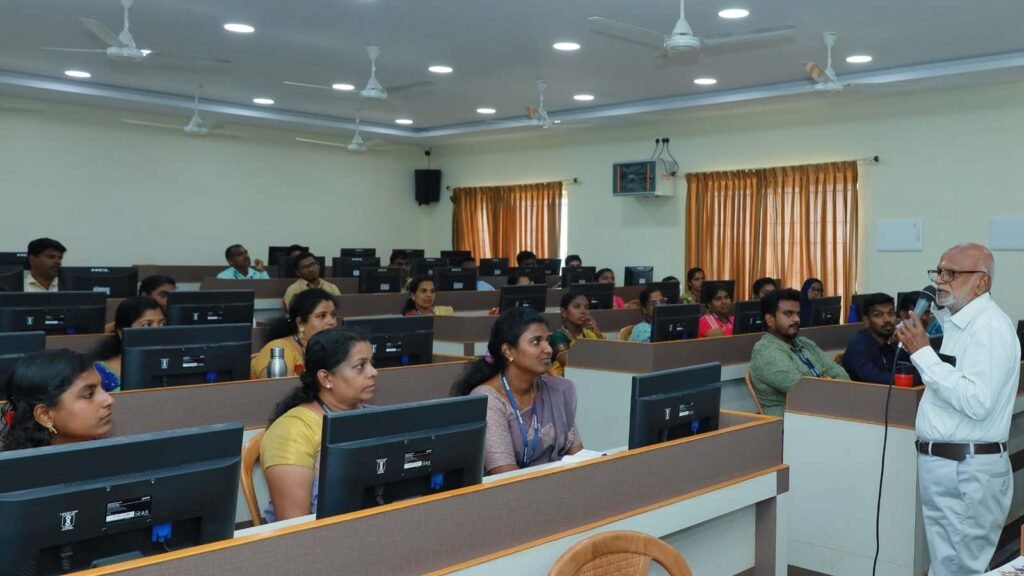
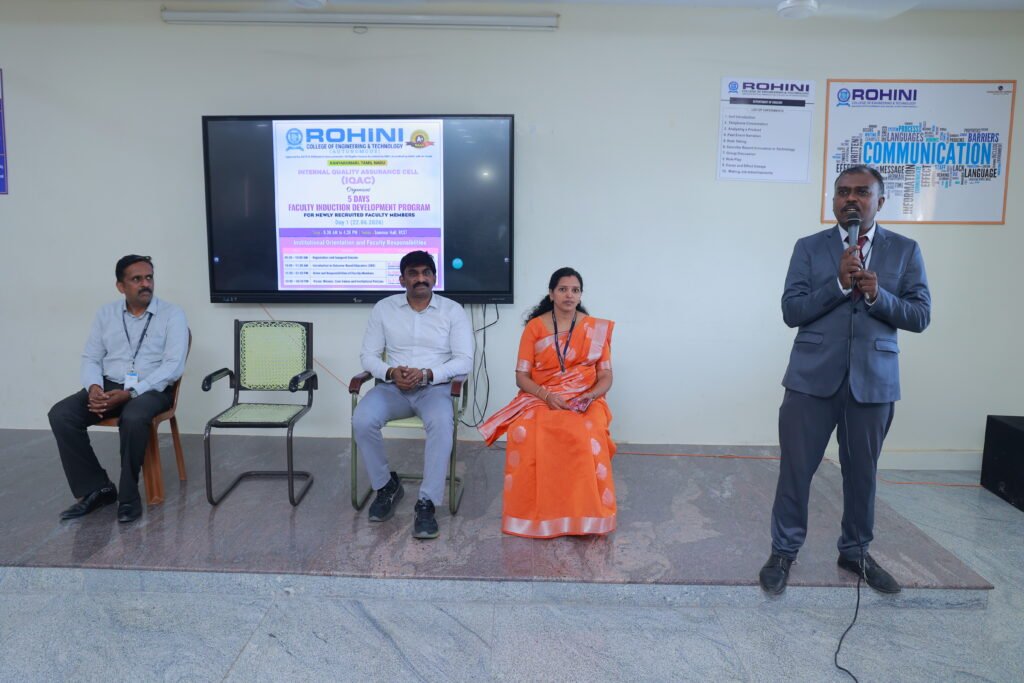
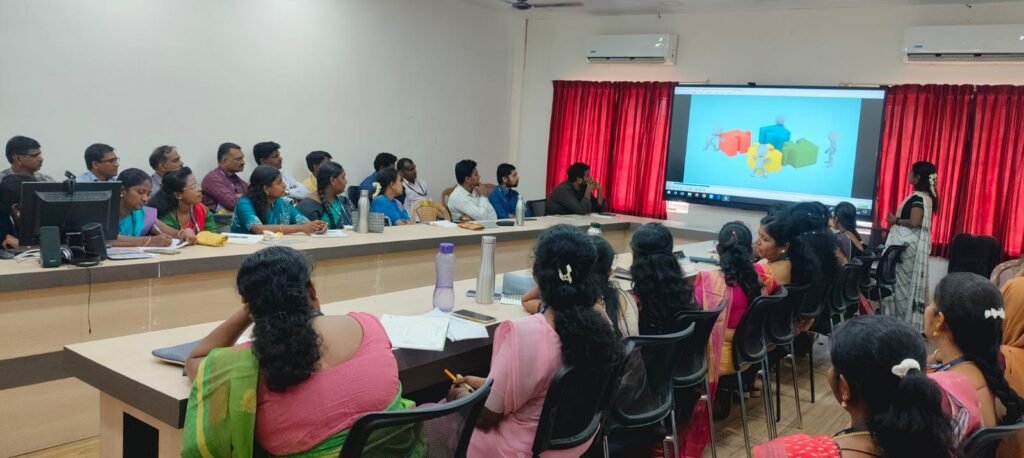
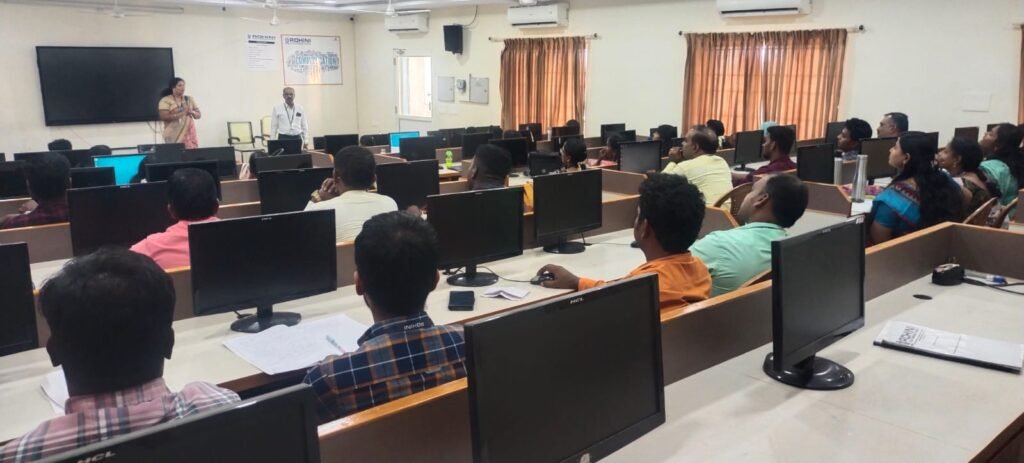
The Internal Quality Assurance Cell (IQAC) of Rohini College of Engineering and Technology (Autonomous), Kanyakumari, successfully organized a 5-Day Faculty Induction Development Programme (FIDP) from 22nd June 2026 to 27th June 2026. The programme was organized to orient and prepare newly recruited faculty members for their academic and professional responsibilities. The programme covered essential aspects of higher education, including effective teaching-learning practices, outcome-based education, institutional policies, professional ethics, research and innovation, quality assurance, student mentoring, digital teaching tools, and the role of next-generation educators. Through expert lectures and interactive sessions, the programme helped participants develop the knowledge, skills, and confidence required to excel in their teaching careers and contribute effectively to the institution.
Day 1 – 22 June 2026
Institutional Orientation and Faculty Responsibilities
The Five-Day Faculty Induction and Development Programme (FIDP) commenced with an inaugural session attended by the Principal, Convenor, Resource person, and newly recruited faculty members. The programme was organized to familiarize the participants with the institution’s academic environment and prepare them for their professional responsibilities.
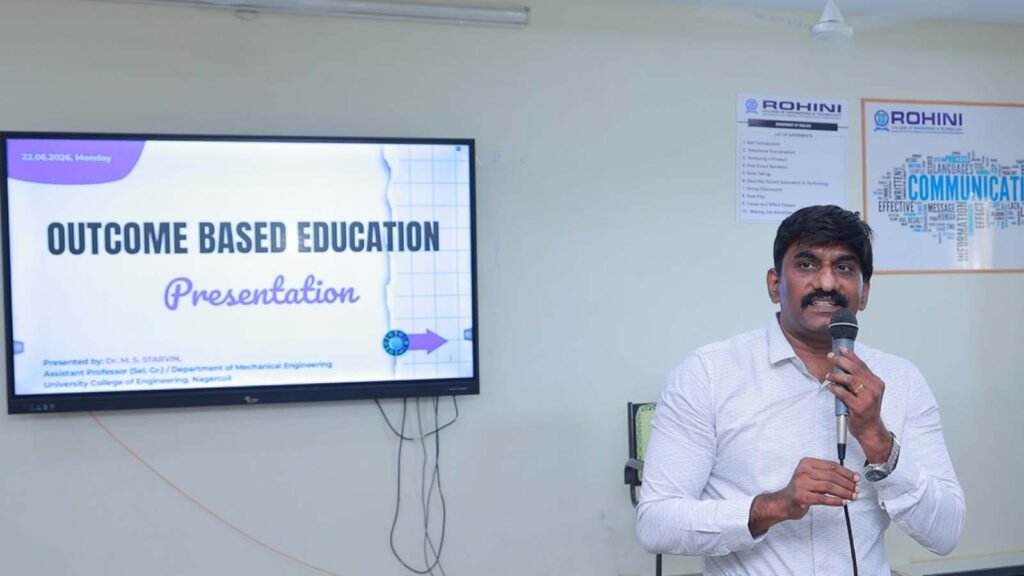
The first technical session on “Introduction to Outcome-Based Education (OBE)” was delivered by Dr. Starwin, Assistant Professor, Department of Mechanical Engineering, University College of Engineering, Nagercoil. The resource person explained the principles of Outcome-Based Education, programme outcomes, course outcomes, and the significance of outcome-oriented teaching and assessment in engineering education.
The second session, “Roles and Responsibilities of Faculty Members,” was handled by Dr. Umaiyorubagan, Principal (Retd.). He highlighted the professional ethics, academic responsibilities, mentoring roles, and leadership qualities expected of faculty members. He also emphasized the importance of lifelong learning and continuous professional development.
In the afternoon, Dr. R. Rajesh, Principal, RCET, conducted a session on “Vision, Mission, Core Values and Institutional Policies.” He introduced the institutional vision and mission, core values, quality initiatives, academic regulations, and administrative policies. The session enabled the newly recruited faculty members to understand the institution’s culture and their role in achieving academic excellence.
The first day concluded with an interactive discussion, providing participants with a strong foundation for their academic journey at the institution.
Day 2 – 23 June 2026
Teaching Excellence and Emerging Educational Technologies
The second day focused on enhancing teaching effectiveness and familiarizing faculty members with modern educational technologies.
The first session on “Principles of Effective Teaching and Learning” was delivered by Dr. M. Reji, Professor and Head, Department of Electronics and Communication Engineering. The session highlighted effective classroom management, lesson planning, student engagement techniques, and strategies to improve learning outcomes.
The second session on “Student-Centric Learning Approaches” was conducted by Mrs. Meenakshiammal, Assistant Professor, Department of Computer Science and Engineering and Associate Dean (Admissions). She explained various learner-centred pedagogies, including active
learning, collaborative learning, problem-based learning, and experiential learning, encouraging faculty members to adopt innovative instructional practices.
The afternoon session on “AI Tools for Education and Research” was delivered by Dr. V. Gopakumar, University Librarian, Digital University Kerala. The resource person demonstrated various Artificial Intelligence tools that support teaching, research, literature review, academic writing, reference management, and presentation development. Participants gained practical exposure to AI-enabled educational resources and explored their responsible use in higher education.
The sessions significantly enhanced participants’ understanding of effective pedagogy and technology-integrated teaching practices.
Day 3 – 24 June 2026
Academic Processes and Outcome Assessment
The third day concentrated on academic quality assurance and institutional academic processes.
The first session on “Beyond the Classroom: Fostering Innovation, Creativity and Entrepreneurship” was handled by Dr. R. B. Benisha, Associate Professor and Head, Department of Bio-Medical Engineering. The session motivated faculty members to cultivate innovation, creativity, and entrepreneurial thinking among students through project-based and experiential learning.
The second session, “CO–PO–PSO Mapping and Attainment Analysis,” was delivered by Dr. N. Amutha Priya, Associate Professor and Head, Department of Electrical and Electronics Engineering. The resource person explained the systematic process of mapping Course Outcomes, Programme Outcomes, and Programme Specific Outcomes, along with methods for calculating attainment and ensuring continuous quality improvement.
The afternoon session on “Campus Management System (CMS), Learning Management Systems (LMS) and Online Assessment Practices” was conducted by Mrs. S. Krishnaveni, Assistant Professor, Department of Agricultural Engineering and Associate Dean (CMS). The session
provided practical guidance on using digital platforms for academic management, online learning, attendance, assessments, and student performance monitoring.
The final session on “Effective Communication and Presentation Skills for Educators” was delivered by Dr. T. S. Varatharajan, Associate Professor and Head, Department of English. The session focused on improving verbal communication, presentation techniques, classroom interaction, and confidence-building skills essential for effective teaching.
The third day’s sessions equipped participants with the academic and communication competencies necessary for quality teaching and institutional effectiveness.
Day 4 – 25 June 2026
Student Support and Academic Documentation
The fourth day emphasized student engagement, mentoring, and assessment practices.
The first session on “Active Learning Techniques and Classroom Engagement Strategies” was delivered by Mrs. R. K. Aswini, Assistant Professor, Department of Civil Engineering. She introduced innovative classroom strategies such as think-pair-share, flipped classrooms, collaborative learning, and interactive teaching methods that enhance student participation and critical thinking.
The afternoon session on “Assessment and Evaluation Methods” was conducted by Dr. S. Subotha, Controller of Examinations, RCET. The resource person explained various assessment techniques, internal evaluation procedures, continuous assessment practices, and methods for ensuring transparency, fairness, and reliability in student evaluation.
The day concluded with fruitful discussions on enhancing student success through effective mentoring and outcome-based assessment practices.
Day 5 – 27 June 2026
The final day focused on academic administration, documentation, and professional development.
The first session on “Student Mentoring, Counseling and Academic Advising” was handled by Dr. Prem Shankari, Associate Professor and Head, Department of Management Studies. The session highlighted the importance of mentoring in supporting students’ academic, personal, and professional development. Faculty members were encouraged to build positive relationships with students and provide timely guidance.
The third session on “Course File Preparation and Academic Documentation” was conducted by Dr. E. Sree Devi, Professor, Department of Bio-Medical Engineering. Participants were guided on maintaining course files, lesson plans, assessment records, and other essential academic documents required for quality assurance and accreditation.
The final technical session on “Preparation of Question Papers, Rubrics and Evaluation Schemes” was delivered by Dr. S. Radhika, Associate Professor and Head, Department of Chemistry. The session emphasized the preparation of quality question papers aligned with Course Outcomes and Bloom’s Taxonomy, along with the development of effective rubrics and transparent evaluation schemes.
The programme concluded with the Valedictory Session, during which participants shared their feedback and reflected on the knowledge gained throughout the programme. Certificates were distributed to all participants, and the organizing committee expressed gratitude to the management, resource persons, and participants for making the Faculty Induction and Development Programme a meaningful and successful initiative.
Outcomes of the Faculty Induction Development Programme
Upon completion of the FIDP, the newly recruited faculty members were able to:
Understand institutional policies, academic regulations, and faculty responsibilities.
Implement Outcome-Based Education (OBE) and student-centric teaching practices.
Integrate AI tools and digital technologies into teaching and research.
Perform CO–PO–PSO mapping and outcome attainment analysis.
Effectively mentor students and adopt innovative classroom engagement strategies.
Design quality assessments, prepare academic documentation, and maintain course files.
Demonstrate professionalism, ethical practices, and a commitment to continuous learning and institutional quality enhancement.
The Five-Day Faculty Induction and Development Programme successfully equipped the newly recruited faculty members with the knowledge and skills required for effective teaching, academic administration, student mentoring, and outcome-based education. The programme enhanced their understanding of institutional policies, innovative pedagogical practices, digital technologies, assessment methods, and quality assurance processes. Overall, the FIDP served as a strong foundation for their professional growth, enabling them to contribute effectively to the institution’s vision of academic excellence and holistic student development.